

Thinking beyond old silos
Europeans and Canada need to be bolder and braver in charting out options for their future security

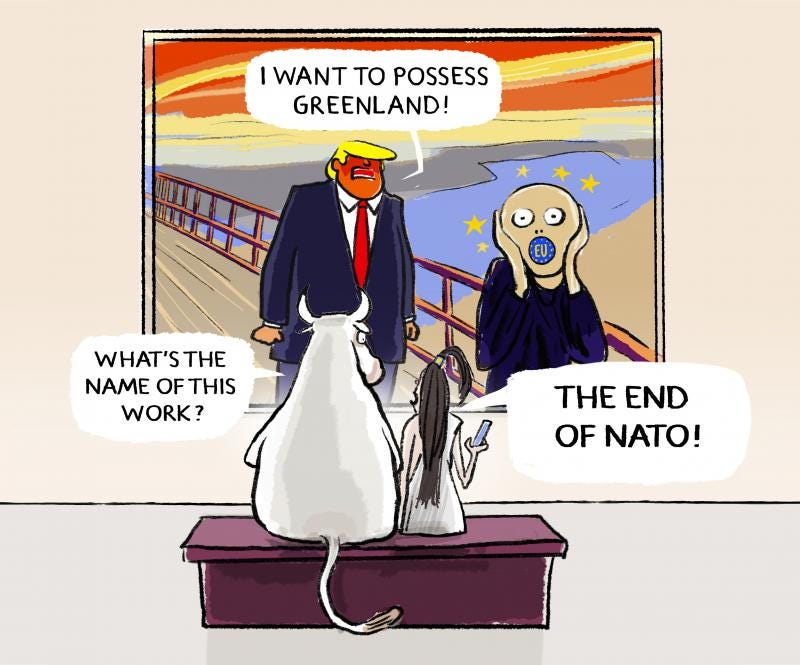
Feeling like Cassandra can be unsettling. In early 2025 I wrote the below as part of a broader policy paper on the future of NATO. With Trump now threatening to annex Greenland, thereby putting NATO’s future in further jeopardy, my analysis remains evergreen…
A potential US withdrawal from NATO would not make the NATO Treaty per se obsolete. At least de iure, it would remain in place. Remaining members may argue that the Alliance is the best and already existing structure for the collective security of all its members. It has a tried and tested machinery, an established international secretariat (both civilian and military), and includes apart from Canada also Norway, the UK and Türkiye as significant non-EU security powers.
Notwithstanding, remaining members cannot pretend that they could do business as usual. For starters, they would be obliged to update NATO’s founding treaty from 1949. Articles 5 and 6 focusing on NATO’s collective defence provisions explicitly refer to include Europe and North America. With the US gone, this would no longer be valid. What is more, NATO’s institutional identity forged over more than 75 years has always centred around the transatlantic link between Europe and US/America. A potential US withdrawal would in essence be the end of NATO as we know it, and would require a fundamental reconceptualization of its strategic outlook and posture.
The resulting political dynamics could well lead to transforming or transitioning NATO into a new European Defence Alliance or Organisation, or broader, a Western Defence Alliance, as a new body and ideally based on a coalition of the willing. Setting up such a new institution could also be a useful move to reinforce European capability to act.
However, there could be an even better way forward: If we want to create the institutional basis for Europeans (and Canada) to become a serious geostrategic actor, we need to stop thinking in old institutional NATO and EU silos which, often based on mutual ignorance, lead to an increasing fragmentation, a growing maze of clouded responsibilities, and often unnecessary duplication.
Therefore, an even more holistic approach with significant strategic advantages would be to undertake this reform jointly from the EU and NATO angle and, in fact, with the overarching goal to create a joint new body, akin to a Western Defence Union. As a basis, both sides would “create a real joint security strategy between the EU and NATO which clearly integrates NATO and EU threat assessments, capability targets, regional and thematic responsibilities” (Volt; 2025). In essence, such a new joint body with its roots in NATO and the EU would be a further development and merger of all EU efforts currently undertaken as part of a future European Defence Union, which currently focuses on support to Ukraine, ramping up European defence industry and production, and investment in defence, with all defence and security efforts undertaken then hitherto in the NATO framework.
As both the EU and NATO are frequently gridlocked by the unanimity or consensus principle, such a new institution based on a coalition of the willing would avoid the notorious blockages from Russia’s Trojan Horses like Orban and Fico. It would include Canada, and in fact should also include Ukraine as the country which is defending European security on its soil. Ideally, a new institution would also opt for a qualified majority voting formula as the standard decision-making process. This would further enhance the institution’s capacity to decide and deliver at speed of relevance.
Such a new framework could also include a mutual defence clause which is more demanding on members than NATO’s Article 5 whereby members only commit to “taking forthwith, individually or in concert with the other Parties, such action as it deems necessary, including the use of force, to restore and maintain international peace and security.”
Political discussions among capitals about reforms of frameworks and structures must be pursued with urgency
.